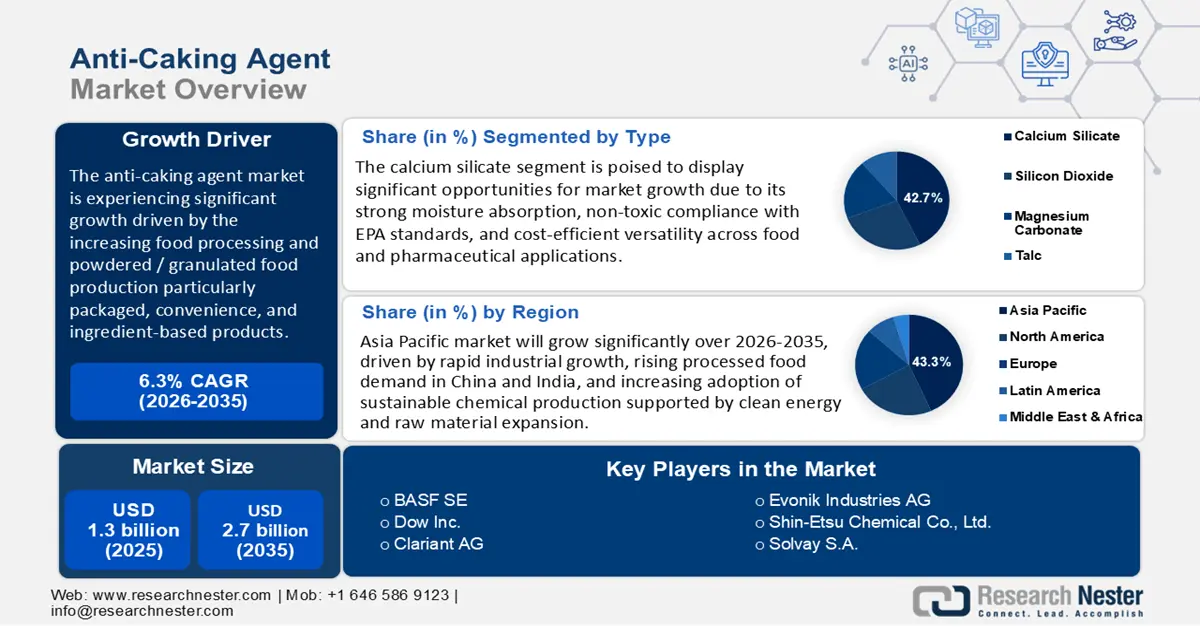
Anti-Caking Agent Market Outlook:
Anti-Caking Agent Market size was valued at USD 1.3 billion in 2025 and is projected to reach USD 2.7 billion by the end of 2035, rising at a CAGR of 6.3% during the forecast period, from 2026 to 2035. In 2026, the industry size of anti-caking agent is estimated at USD 1.4 billion.
The anti-caking agent market is anticipated to grow significantly over the forecast period, primarily driven by the increasing food processing and powdered/granulated food production, particularly packaged, convenience, and ingredient-based products. This causes more of the additives that stop clumping, improve flow, and shelf life to be used. The Producer Price Index (PPI) of the commodity of materials used in the food additive production (which would also entail raw materials) was 264.996 in January 2025 (seasonally adjusted), with a year-on-year-month growth of +5.9. In addition, the rising demand from the food sector, especially for processed and convenience food items, is further stimulating the growth of the market globally. As reported by the U.S. Department of Agriculture (USDA), the global market for anti-caking additives was estimated to be around USD 3.6 billion in 2022, with forecasts suggesting an annual growth rate of 5.3% over the next five years. This expansion is linked to the necessity of preserving product quality and shelf life in powdered food products.
The supply chain for raw materials used in anti-caking agents encompasses the procurement of minerals and chemicals from diverse regions, with notable production capabilities found in nations such as China and India. For example, China has exported anti-caking agents to more than 10 countries. The growth in manufacturing capabilities is highlighted by investments in facilities like Evonik's hydrophobic fumed silica plant located in Germany. Since most anti-caking agents are mineral-based (e.g., silicates, phosphates, calcium/magnesium compounds) and chemical-based, their supply chain is very reliant on raw materials (e.g., phosphates, silicates, salts, etc.), which are usually mined or manufactured in areas with access to mineral deposits. As an example, the U.S. Economic Research Service (USDA ERS) provides data on fertilizer imports/exports. In the case of mineral or chemical fertilizers containing phosphorus, in 2023, the U.S. exported minerals to Canada of approximately USD 1,535,480 (thousand USD) of about 662,093 Kg. Also, the fertilizer trade statistics indicate the high dependence on the imported raw materials, particularly on potassium (potash) and phosphates. The data on fertilizers and raw minerals in global trade is high in terms of quantity and quality, and there are indications that the supply of some of the raw inputs is available but influenced by the trade policy, tariffs, and supply inputs. For example, since 2020, net imports of phosphate rock in the U.S. have contributed to the annual consumption, which amounts to about 6% to 16%.