Anesthesia Breathing Circuits Market - Regional Analysis
North America Market Insights
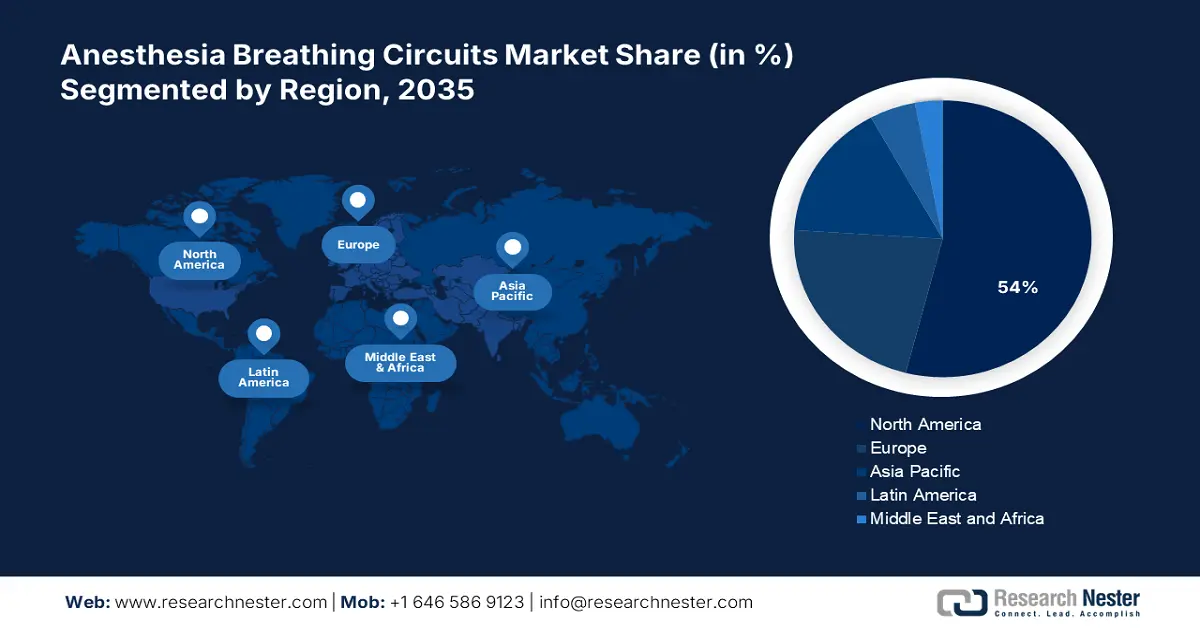
North America is anticipated to hold the largest share of 54% in the global anesthesia breathing circuits market by the end of 2035. The developed medical facilities, high volume of surgeries, and the enlarging patient pool of chronic conditions are solidifying the region’s forefront position in this sector. The presence of globally leading research institutions and MedTech pioneers, coupled with strict healthcare-associated infection (HAI) regulations, is creating a favorable environment for this merchandise. The progressive characteristics of the landscape can further be testified by the launch of a new sustainable model for anesthesia by UCSF Health in February 2025, which is equipped with multi-use breathing circuits.
According to a study published by the NLM in September 2024, the expense of each VPA incidence in the U.S. accounted for $40.1 thousand. Besides, chronic illnesses are attributable to an annual expenditure of $1 trillion for the country’s healthcare system, where 50% of nationwide preventable disease deaths originate from sedentary lifestyles, such as inactivity, poor nutrition, tobacco use, and excessive alcohol consumption, as unveiled by another 2024 NLM findings. These figures display a clear picture of the underlying growth factors in the market.
Canada also plays a prominent role in the North America anesthesia breathing circuits sector on account of its publicly funded healthcare system. The steady rise in procedural volumes across the country also proves the presence of a sustainable demand in this sector. This can be evidenced by a report from the Canadian Institute for Health Information, published in October 2024. It revealed that the number of day surgeries alone surged by 10% between the timelines 2019-2020 and 2023-2024. Another NLM study calculated the count of new and death cases of cancer in Canada to surpass 247.1 thousand and 88.1 thousand, respectively, in 2024.
APAC Market Insights
Asia Pacific is poised to emerge as the fastest-growing region in the global anesthesia breathing circuits market during the assessed tenure. Rapid infrastructural development in healthcare, increasing surgical volumes, and rising intensive care awareness across developing countries, such as China, India, and Japan, are propellers of the region’s augmentation in this field. The growing middle-class population, expanding access to advanced medical services, and government investments in healthcare modernization are also accelerating the pace of growth in the region. Besides, the rising occurrence and mortality of chronic ailments and a growing elderly population are amplifying the interventional volumes, which ultimately contribute to the escalating position of the region in this sector.
China is establishing itself as the growth engine of the Asia Pacific anesthesia breathing circuits industry, which is fueled by its robustly expanding medical device industry and increasing demand for surgical procedures. The demographic expansion across the nation can further be exemplified by the count of preterm births in 2023 alone, accounting for 0.7 million, according to the NLM findings. China is also indicating its significance in this sector through its excellence in localized production of reliable and cost-effective ABC integrated systems.
India is witnessing rapid progress in the anesthesia breathing circuits market, backed by an increasing number of surgeries, a large patient population, and developing healthcare infrastructure. Government initiatives aimed at improving access to quality medical facilities, along with the rise of private hospitals and medical tourism, are fueling demand for effective and affordable anesthesia equipment. In this regard, an NLM report unveiled that an average of 2770 surgeries were being performed in India per 100 thousand people till 2023.
Countries with the Highest Preterm Birth Rates in APAC (2023)
|
Country |
Preterm Birth Rates (in %) |
|
India |
13.0 |
|
Pakistan |
14.4 |
|
Bangladesh |
16.2 |
Source: NLM
Europe Market Insights
Europe is expected to maintain a consistent growth in the anesthesia breathing circuits market over the timeline between 2026 and 2035. Such augmentation of the region in this sector is empowered by the strong presence of well-developed healthcare infrastructure and high patient safety standards. Currently, technologically developed countries, such as Germany, the UK, and France, are the leading contributors in this landscape with a high volume of surgical procedures and ongoing innovation in medical technologies. Furthermore, the enlarging geriatric population and increasing prevalence of chronic conditions also contribute to sustained demand for anesthesia services, and hence, Europe offers lucrative opportunities for both domestic and foreign pioneers.
The UK empowers the regional progress in the market with ongoing healthcare reinforcement initiatives. The regulations enacted by the National Health Service (NHS) play a critical role in ensuring widespread access to surgical care, contributing to consistent demand for anesthesia equipment. On the other hand, the rising surgical caseload, with over 0.1 million surgical operations performed across the UK between 2023 and 2024, creates a substantial surge. However, the shortfall of trained anaesthetists may impact the overall adoption rate in this sector.
Germany is one of the leading contributors to the Europe anesthesia breathing circuits market. The increase in MedTech innovation and procedural volume is magnifying the country’s significance in this sector. Besides, the growing focus on hospital hygiene and infection prevention also promotes advancements in breathing circuits. Additionally, rapid aging among citizens, where 18.6 million people in Germany were aged 65 and over, and 6.1 million of them were 80 years and older, is boosting demand in this category.
Country-wise Density of Anesthetists (2022)
|
Country |
Anesthetists per 100,000 People |
|
Germany |
37.4 |
|
Switzerland |
30.9 |
|
Russia |
27.1 |
Source: ROCA