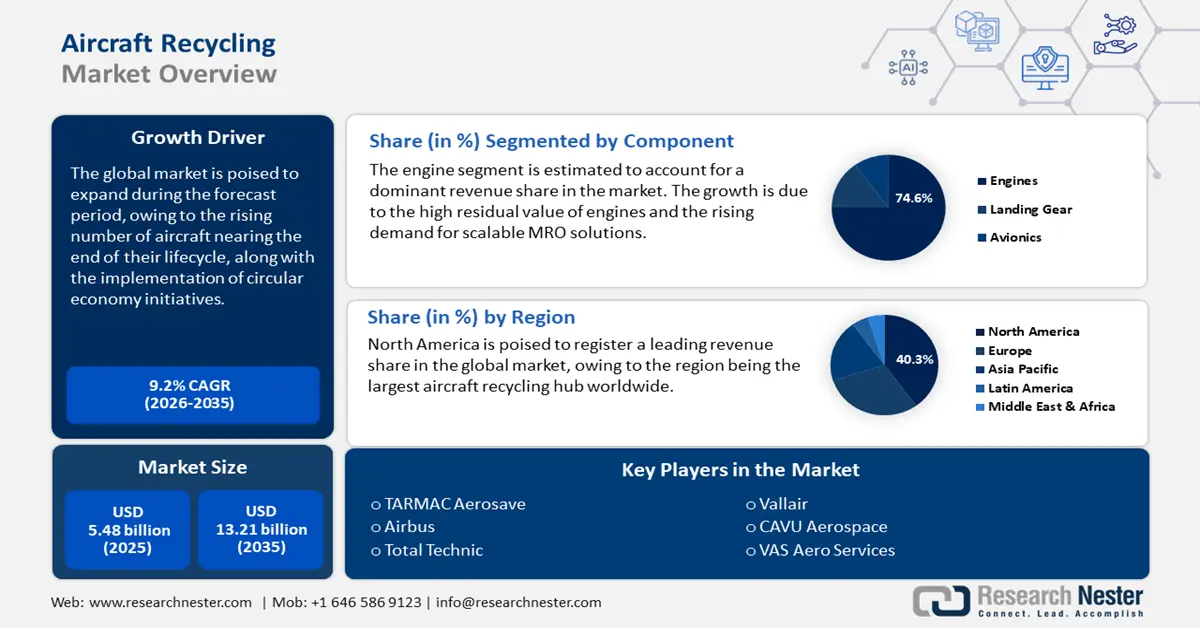
Aircraft Recycling Market Outlook:
Aircraft Recycling Market size was over USD 5.48 billion in 2025 and is projected to reach USD 13.21 billion by 2035, growing at around 9.2% CAGR during the forecast period i.e., between 2026-2035. In the year 2026, the industry size of aircraft recycling is evaluated at USD 5.93 billion.
The aircraft recycling industry is dependent on the guidelines provided by the Aircraft Fleet Recycling Association (AFRA) on import and export regulations, tax considerations, customs valuations, and various restrictions on export. In the economic indicators of the sector, the Producer Price Index (PPI) for final demand has notably increased by 0.6% in March 2025. The change highlights a minuscule reduction in the prices received by producers for their output. Additionally, the Consumer Price Index (CPI) has notably increased for all urban customers by around 2.6% in one year from March 2024 to March 2025. The increase is an indication of a general spike in consumer prices.
Key Trends
|
Category |
Metric |
Value |
Year |
|
Aircraft Recycling Supply Chain |
Estimated number of aircraft disassembled and recycled annually |
410–460 aircraft |
2023–2024 |
|
|
The estimated value of the aircraft parts market is driven by recycle Ng |
$2.3 billion |
2023 |
|
Producer Price Index (PPI) |
Final demand (seasonally adjusted) |
-0.6% |
March 2025 |
Furthermore, the growth in investments to bolster technological advancements has become a cornerstone in improving the efficiency of the recycling process. The FAA’s Continuous Lower Energy, Emissions, and Noise (CLEEN) program, which began in 2010, reflects profitable private-public partnerships to bolster the development of aircraft technologies that are sustainable. In concurrence, the EC Leach technology has been attracting considerable investment, with an incentive package above USD 1 billion allocated for Platinum Group Metals in El Salvador. The trends bode well for the market’s consistent growth during the anticipated timeline.