AI in Retail Market - Growth Drivers and Challenges
Growth Drivers
- Improved supply chain and inventory optimization: Retailers are using AI more and more to develop more robust and effective supply chains, from demand planning to managing stocks. A vital element is the capability of AI to examine enormous sets of information and yield actionable insights that lower costs and avoid stockouts. For example, Accenture announced its acquisition of retail technology services company Logic in August 2024 to enhance its strength in driving AI-powered transformations in merchandising and supply chain responsiveness. This emphasis on AI-based operational effectiveness is aiding retailers in their ability to operate in a challenging and competitive environment.
- Customer personalization: AI is transforming the way retailers engage with their customers by facilitating highly personalized shopping experiences, from product suggestions to conversational service. Its capacity to deliver personalized content and support at scale is a significant growth driver. Salesforce introduced Einstein Copilot for Shoppers, a generative AI-based conversational assistant in February 2024 that comes integrated directly into its Commerce Cloud to offer personalized product recommendations and support. This reflects the sector's move toward leveraging AI to create richer, more meaningful customer relationships.
- Creation of popular AI platforms: The presence of nimble AI platforms and microservices is making it possible for retailers to construct individualized applications specific to their own demands. This is fueling innovation and enabling companies to create novel solutions for distinct challenges in such areas as demand forecasting, visual search, and customer service. NVIDIA expanded its retail AI platform in January 2025 with new microservices that allow retailers to create custom generative AI apps for inventory management, supply chain optimization, and virtual assistants. This shift towards scalable, customizable AI solutions is a key growth driver in the market.
Online Retail Sales as a Share of Total Retail (2023)
Online retail sales surged during the pandemic, reaching as high as 25 to 30% of total retail in China, the U.K., and Korea, while the U.S. stands at 15% and most other markets remain in the 5-10% band. This concentration of online activity is accelerating adoption of AI in retail, from demand forecasting to real-time personalization.
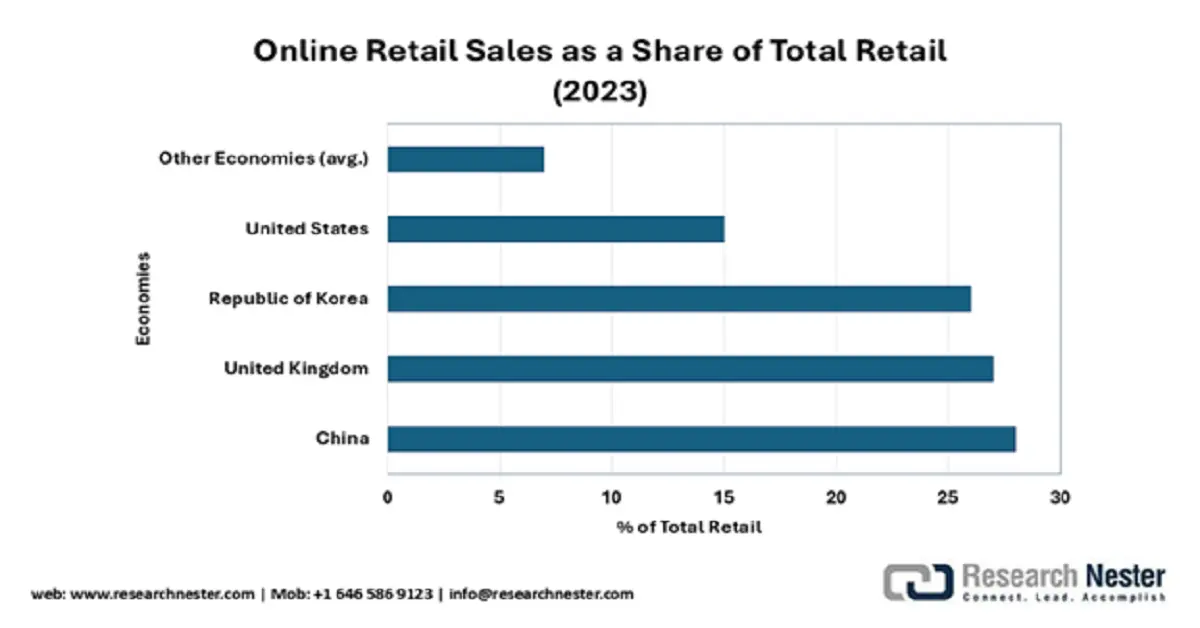
Source: UNCTAD
AI Adoption and Productivity in Retail and Related Sectors (2023)
|
Aspect |
Key Figures / Insights |
Impact on Retail |
|
AI Adoption vs. Productivity |
Among the 10% most productive firms in Belgium, Germany, Italy, and Korea, AI usage is nearly 2× higher than among the bottom 10% |
High-productivity retailers benefit most from AI for forecasting, personalization, and supply chain optimization |
|
Complementary Assets |
Productivity gains depend on ICT systems, digital infrastructure, management skills, and problem-solving abilities |
Retailers must pair AI with robust digital platforms and staff training to fully capture value |
|
Human Capital Needs |
Over 30% of U.S. online job postings from top AI employers mention management or leadership skills, beyond technical expertise |
Retail businesses adopting AI should invest in leadership, innovation, and analytics skills to align teams with AI-driven operations |
|
Sector Concentration |
28% of ICT firms in OECD countries used AI in 2023, compared with an 8% average across all firms |
While AI is still concentrated in ICT, retail adoption is expanding as omnichannel commerce and personalization gain importance |
|
Firm Size Dynamics |
Large firms are about 2× more likely to use AI than SMEs (<250 employees) |
Bigger retailers often lead in AI investment, but SMEs can leverage cloud AI tools to bridge the gap |
|
Firm Age Variation |
In France and Denmark, younger firms show higher AI use than older peers |
New retail entrants and startups may adopt AI faster, enabling innovation in customer experience and inventory systems |
Source: OECD
Challenges
- Regulatory scrutiny and compliance: The increased application of AI in retail has drawn greater regulatory attention, specifically regarding data privacy and consumer protection, resulting in a multifaceted compliance environment for companies. One of the main challenges is making sure AI-based tools, including those applied to pricing analytics and customer support, are utilized in an open and equitable fashion. In September 2024, the U.S. Federal Trade Commission (FTC) issued Operation AI Comply, a law enforcement sweep targeting deceptive AI assertions. This move serves notice that retailers need to be careful in the way they advertise and implement AI solutions to prevent legal and reputational consequences.
- Integration with legacy systems: Merging sophisticated AI solutions with legacy systems proves to be a significant operational barrier for most retailers, typically involving substantial investment and technical know-how. The intricacy of integrating separate systems can hinder the implementation of new AI technologies and restrict their functionality. One similar challenge is protecting data and interoperability between new and existing platforms. In July 2024, the UK and India initiated the UK-India Technology Security Initiative, whose goal is to standardize security protocols for technology, impacting SaaS providers that offer AI services for retail. This underscores the need to tackle integration and security issues to gain maximum benefits of AI in the retail market.
AI in Retail Market Size and Forecast:
|
Base Year |
2025 |
|
Forecast Year |
2026-2035 |
|
CAGR |
24% |
|
Base Year Market Size (2025) |
USD 14.4 billion |
|
Forecast Year Market Size (2035) |
USD 123.7 billion |
|
Regional Scope |
|

