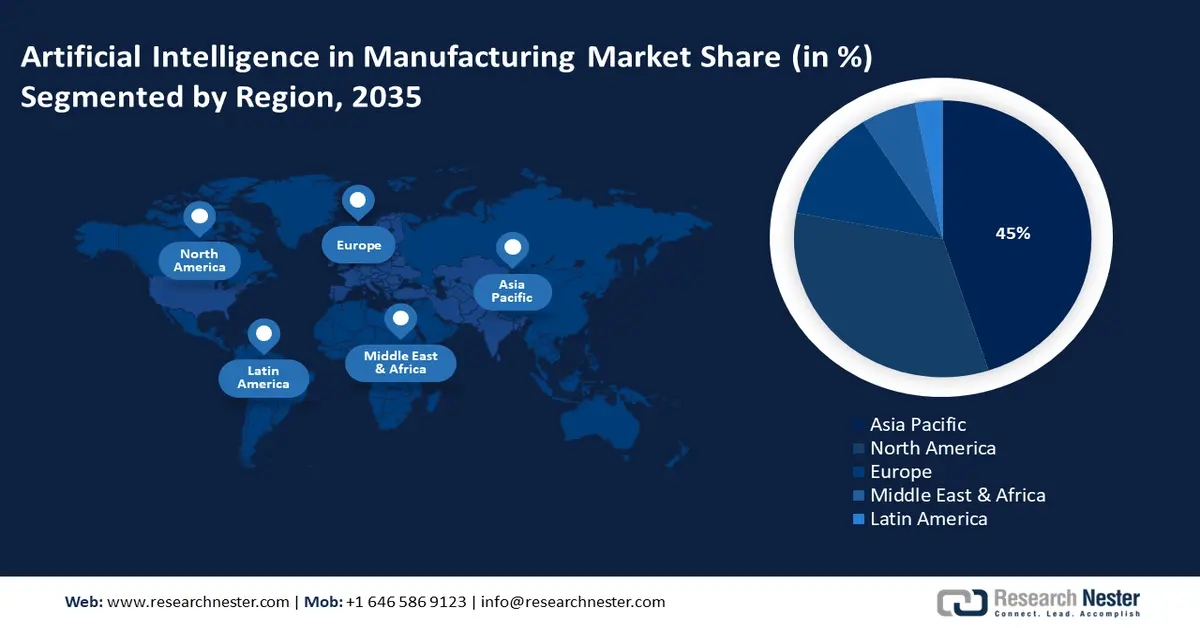
Artificial Intelligence in Manufacturing Market Regional Analysis:
Asia Pacific Market Insights
Asia Pacific is expected to dominate the market with a 45% share through 2035 due to the rising implementation of smart factories and Industry 4.0 technologies. Governments worldwide are investing heavily in AI-driven automation to enhance productivity. Thus, initiatives such as the Digital India and Society 5.0 are promoting the adoption of smart factory technologies, which is fueling the integration of AI into supply chain and production processes. For instance, in 2024, Hitachi introduced an AI-driven industrial platform in Southeast Asia aimed at enhancing factory operations by utilizing real-time data. Numerous manufacturing industries, ranging from electronics to automotive, use predictive maintenance and automation of processes to work at ease. Moreover, the increasing number of skilled professionals in AI and data analytics is further propelling this growth.
The artificial intelligence in manufacturing market in China is driven by its national objective to establish itself as a global leader in intelligent manufacturing, supported by substantial investments from both government and private entities. The Made in China 2025 initiative highlights the importance of automation, robotics, and AI-enhanced quality control to boost international competitiveness. In contrast to other countries, China possesses unrivaled access to extensive datasets, which utilize ML algorithms for detecting defects and optimizing processes. Major domestic technology companies like Baidu and Huawei are partnering with factories to create proprietary AI models specifically designed for local production.
The artificial intelligence in manufacturing market in South Korea is expanding due to emphasis on hyper-automation, semiconductors, and consumer electronics. The growth also depends on the government's AI National Strategy, which is focused on integrating AI to enhance precision and minimize downtime in production industries. The presence of robust small and medium enterprises such as Samsung and LG influences innovation and implementation.
North America Market Insights
North America is anticipated to capture a substantial share from 2026 to 2035. In North America, the market is expanding due to the demand for resilient, automated supply chains. The development of AI-driven robotics and digital twins is fueled by advanced research and development facilities and access to venture capital. Manufacturers are encouraged to embrace AI for smart energy management due to the regulatory emphasis on energy efficiency and sustainability.
The U.S. artificial intelligence in manufacturing market is expanding due to rising need for innovation in the automotive, aerospace, and electronics industries. U.S. manufacturers are adopting AI technologies to streamline intricate processes, improve accuracy, and prevent human mistakes. The U.S. tech landscape encourages partnerships between startups and established companies to facilitate progress. For instance, in June 2023, Lockheed Martin collaborated with Xaba to incorporate AI-powered cognitive robotics into airframe manufacturing that improved robotic accuracy tenfold and improved efficiency in drilling operations on aluminum test plates. This resulted in lower production costs in the aerospace sector.
In Canada, the artificial intelligence in manufacturing market is rapidly rising as the nation prioritizes sustainable manufacturing and green technology initiatives. With governmental backing for clean-tech projects, AI is being utilized to enhance energy efficiency and reduce waste in industrial processes. Additionally, the robust academic research infrastructure in Canada encourages the development of AI-driven innovation. A recent innovation is the launch of Husky A300 by Clearpath Robotics in October 2024. This autonomous mobile robot, built for agriculture and mining operations, increases material handling productivity by 25%, showcasing how AI can improve operational effectiveness across various sectors.