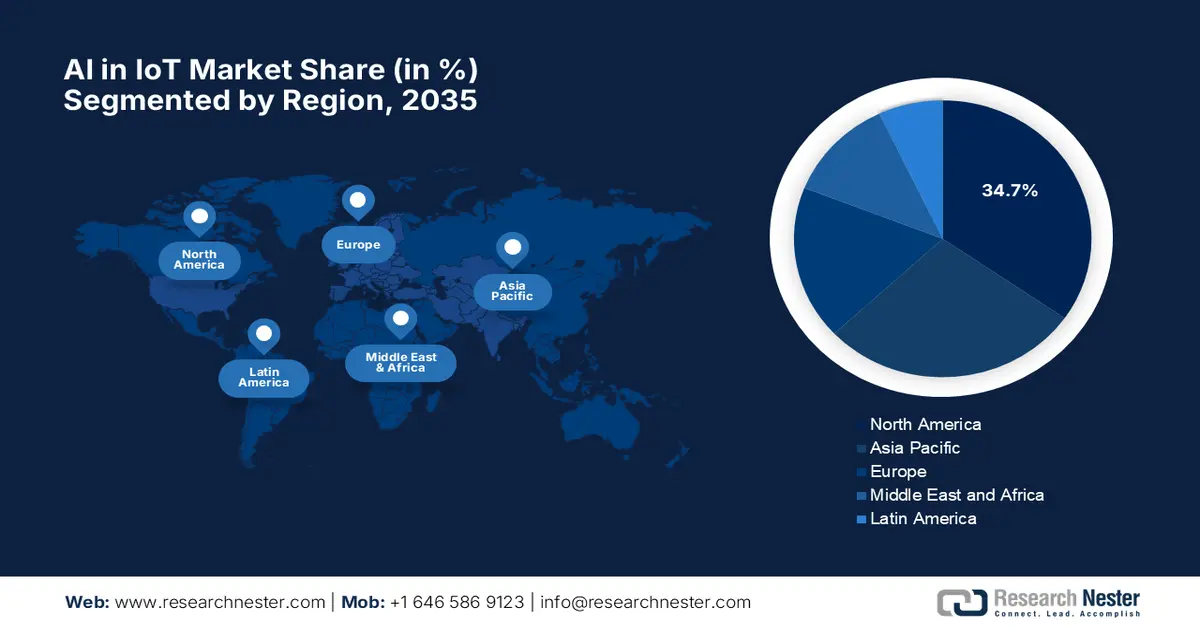
AI in IoT Market - Regional Analysis
North America Market Insights
North America is anticipated to lead the international artificial intelligence in IoT market with the largest revenue share of 34.7% by the end of 2035. The region’s dominance in this field is attributable to mature digital infrastructure, strong enterprise AI IoT adoption in smart manufacturing, healthcare, and logistics. In this regard, Lantronix Inc. in October 2025 announced the launch of Kompress.ai, which is an AI-powered subscription platform for energy-intensive industries, in partnership with Vodafone IoT. The firm also states that this platform integrates Lantronix’s edge hardware, cloud intelligence, and Vodafone’s IoT connectivity to provide real-time insights, predictive analytics, and automation for industrial air compressor fleets. Furthermore, Kompress.ai helps companies reduce downtime, cut energy costs by up to 30% by supporting Lantronix’s recurring revenue model, hence making it suitable for standard artificial intelligence (AI) in IoT market growth.
The U.S. in the AI in IoT market is growing on account of increased adoption, efficiently fueled by advanced cloud platforms and widespread enterprise IoT deployments. Federal initiatives and smart city projects support AI-enhanced traffic management, energy optimization, and predictive maintenance systems. Synaptics Inc. in October 2025, notified that it has launched the Astra SL2600 Series, which are multimodal Edge AI processors designed for intelligent IoT devices across smart appliances, industrial automation, healthcare, and robotics. Besides, these processors are powered by the Torq Edge AI platform and Google’s Coral NPU, and they also offer high efficiency, security features, and connectivity, thereby enabling scalable AI workloads at the edge. In addition, the SL2600 series supports a wide range of applications by accelerating development through open-source compilers and integrated Arm and Mali technologies.
Canada is witnessing growth in artificial intelligence in IoT market due to government-backed AI research programs and industrial partnerships. Simultaneously, the country is also focused on sustainable industrial processes, smart grid solutions, and healthcare IoT applications, wherein AI helps to monitor environmental conditions, optimize energy consumption, and improve patient outcomes. In April 2025, Bell Canada and Ericsson reported that they field-tested AI-native link adaptation, which is a first-of-its-kind technology in 5G networks and was developed at Ericsson’s Ottawa R&D site. Besides, this AI-based solution dynamically optimizes network performance in real time, improving downlink throughput by up to 20% and spectral efficiency by up to 10%, even under very challenging signal conditions. Hence, the collaboration highlights the prominence of AI integration in IoT-enabled telecom infrastructure, contributing to overall artificial intelligence (AI) in IoT market upliftment.
APAC Market Insights
Asia Pacific is likely to register the fastest growth in the global AI in IoT market, wherein the adoption is mainly influenced by smart city initiatives, industrial modernization, and digital transformation strategies. The region extensively emphasizes localized AI applications, such as intelligent transport, agricultural automation, and predictive infrastructure maintenance, in which IoT sensors are generating large amounts of real-time data for AI processing. In December 2025, SoftBank Group announced that it had acquired DigitalBridge for USD 4 billion with a prime focus on expanding digital infrastructure, including data centers, fiber networks, and edge platforms, thereby enabling scalable AI deployment. The firm also notes that the deal strengthens SoftBank’s ability to support next-generation AI services, improve connectivity for IoT ecosystems, and accelerate industrial and enterprise AI adoption.
China is efficiently growing in the artificial intelligence in IoT market on account of continued innovations in areas such as smart manufacturing, autonomous logistics, and industrial robotics. National policies and technology investments encourage domestic development of AI chips, IoT connectivity standards, and integrated platforms that enable large-scale deployment of AI-enabled IoT solutions. In March 2025, ZTE and China Mobile announced that they had unveiled their 5G‑A × AI Ambient IoT solution at MWC Barcelona 2025 by integrating AI with 5G‑A connectivity, sensing, and computing to support IoT device deployments. Besides, this solution includes AI-enhanced Ambient IoT base stations and management platforms that enable real-time decision‑making and ultra-low‑power connectivity across industrial and smart campus environments. Hence, this release demonstrates how the domestic technology companies are embedding AI into IoT infrastructure to drive next-gen connected systems and intelligent automation.
In India, AI in IoT market is growing exponentially due to the increased utilization in agriculture, healthcare, and urban management. The country’s market also benefits from startups that are combining AI with IoT devices to improve crop yields, monitor health services in remote areas. Government programs supporting digital adoption and AI skill development efficiently accelerate regional artificial intelligence (AI) in IoT market progression. In this regard, the government of India, in December 2025, reported that the country is accelerating its AI-based transformation through the IndiaAI Mission, with more than ₹10,300 crore (approximately USD 1.24 billion) investment and 38,000 GPUs deployed to support startups, research, and public services. In addition, it also mentioned that AI initiatives are enhancing sectors such as healthcare, agriculture, education, and governance, by also promoting digital inclusion through homegrown models such as BharatGen AI and Bhashini, positioning the country as the world’s third most AI-competitive nation.
Key Metrics of India’s AI Ecosystem and Government Initiatives (2025)
|
Metric |
Value |
|
India AI Mission Investment |
₹10,371.92 crore (nearly USD 1.25 billion) |
|
Tech & AI Workforce |
6 million |
|
Indian Tech Sector Revenue (2025) |
USD 280 billion (₹23,240 crore) |
|
Projected AI Economic Impact by 2035 |
USD 1.7 trillion |
|
Number of AI Startups |
1.8 lakh (89% using AI) |
|
Global Capability Centres |
1,800+ (500+ focused on AI) |
|
AI Model & Dataset Platform (AIKosh) |
5,500+ datasets, 251 models |
|
AI-skilled Professionals under Future Skills |
13,500 scholars (500 PhD, 5,000 PG, 8,000 UG) |
Source: Government of India
Europe Market Insights
Europe is solidifying its position in the AI in IoT market due to the presence of strong regulatory compliance, privacy protection, and industrial innovation. The region is mainly focused on integrating AI with IoT for smart mobility, while promoting interoperability between devices across borders. In June 2025, Bosch announced that it is investing more than USD 2.7 billion in AI to drive innovation across assisted and automated driving, manufacturing, and consumer applications. By leveraging agentic AI and multi-agent systems, the firm enhances safety, efficiency, and productivity by providing AI platforms for other companies. On the other hand, through initiatives such as its AI Academy, Bosch is also training thousands of employees to build AI expertise, reinforcing its leadership in AI-driven industrial and mobility solutions, hence making it suitable for standard artificial intelligence (AI) in IoT market growth.
Germany is augmenting its leadership over the regional landscape of artificial intelligence in IoT market, facilitated by a stronger emphasis on Industry 4.0 and precision manufacturing. Companies in the country are leveraging AI-driven IoT platforms for real-time quality control, autonomous factory operations, and predictive analytics, encouraging more players to make investments in the country. In this regard, OECD in November 2025 disclosed that Germany is efficiently advancing AI through a strong national strategy, investments in digital infrastructure, high-performance computing, and data governance to support research, industry, as well as public administration. It also highlighted that initiatives of Gaia-X, HPC programs, and AI centers of excellence foster innovation, SME adoption, and industry-academia collaboration. Furthermore, the focus on ethical AI and sustainability, the country positions itself as a predominant leader in AI research and practical applications within Europe.
In the U.K., the AI in IoT market is showcasing exceptional growth facilitated by the rising acceptance of AI IoT in urban infrastructure, healthcare, and logistics. Smart city projects in the country integrate IoT networks with AI analytics to optimize transportation and manage public services, allowing a continued revenue stream in the artificial intelligence (AI) in IoT market. Simultaneously, public-private partnerships encourage experimentation with AI-enabled IoT platforms, thereby supporting both sustainability and economic growth. In February 2025, Thales announced that it had launched the cortAIx centre in the country by bringing on board 200 specialist AI and data engineers to drive domestic innovation in AI-enabled solutions spanning defence, industrial systems, and connected infrastructure. Further, this expansion is also aligned with national AI growth strategies and fosters integration of advanced AI algorithms with sensor-rich environments, underscoring the role of intelligent analytics in IoT ecosystems for secure operational control.