AI Chip Market - Regional Analysis
North America Market Insights
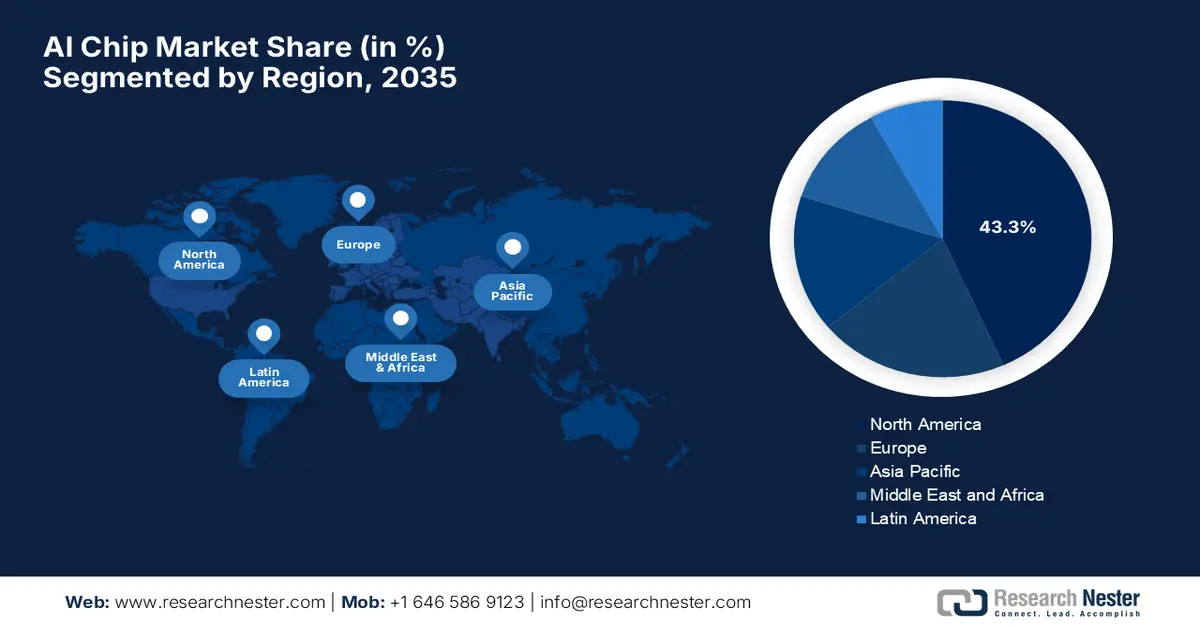
North America is expected to dominate the international artificial intelligence chip market with a share of 43.3% by the end of 2035. The region’s dominance in this field is efficiently propelled by rising public and private investments. The presence of key market players and their continued innovations is also fostering a profitable business environment in the region. In this regard, Apple in October 2025 announced its M5 system-on-a-chip, delivering a major leap in on-device AI performance with over 4× peak GPU compute for AI versus M4, powered by a next-generation GPU with built-in Neural Accelerators, a faster CPU, and an enhanced Neural Engine. It was built on third-generation 3nm technology. M5 significantly boosts unified memory bandwidth and energy efficiency, enabling advanced AI workloads such as local LLMs and diffusion models across MacBook Pro, iPad Pro, and Apple Vision Pro. Hence, such instances reinforce Apple’s growing influence in the market by advancing high-performance, power-efficient AI compute directly on consumer devices without any reliance on the cloud.
The U.S. is considered to be the key growth engine for the upliftment of the regional artificial intelligence (AI) chip market, owing to the widespread adoption of AI-based applications in various industries. The country’s market also benefits from a strong consumer base and substantial federal grants from the government. In October 2025, Intel unveiled the Panther Lake architecture, which is the first AI PC platform built on the advanced Intel 18A process, delivering major gains in AI acceleration, CPU, and GPU performance for client and edge devices. Along with Panther Lake, Intel previewed its 18A-based Xeon 6+ Clearwater Forest server processors, highlighting improved efficiency and scalability for AI-based data centers. In addition, this launch reinforces Intel’s strategic push in AI-focused CPUs and manufacturing leadership, strengthening its position in the evolving global artificial intelligence chip market dynamics.
In Canada, the AI chip market is growing on account of the presence of research institutions and startups, which are focusing on healthcare and natural language processing applications. The country’s emphasis on AI ethics and privacy has also fostered the development of locally optimized edge AI chips for secure deployments. In September 2025, TELUS announced that it had launched the country’s first-ever fully sovereign AI Factory in Rimouski, Quebec, to provide advanced AI compute capabilities with NVIDIA GPUs and HPE infrastructure by ensuring full control over data and operations in the country. The firm also underscored that this facility enables businesses, researchers, and public institutions to train, fine-tune, and deploy AI models securely within Canada. In addition, it is powered by 99% renewable energy and TELUS’ PureFibre network. The AI Factory supports AI innovation across various sectors while also maintaining data sovereignty.
APAC Market Insights
Asia Pacific is anticipated to register the fastest growth in the international AI chip market owing to the rising adoption of AI chips across the manufacturing and robotics sectors. Governments in this region are proactively making investments in semiconductor R&D hubs, supporting both domestic AI startups and large-scale production facilities to accelerate AI hardware innovation. In this context, EdgeCortix announced that it has raised over YEN 17 billion (about USD 110 million) through a combination of venture capital funding and government grants, and is considering further fundraising to accelerate growth. The Series B round, which closed in stages between August and November 2025, attracted both new and existing investors and will be used to expand engineering efforts for its chiplet-based accelerator, SAKURA-X. It is especially designed for applications such as robotics, telecommunications, aerospace, defense, and industrial automation. SAKURA-X is expected to drive cost-effective processing for complex commercial applications.
China is solidifying its dominance over the regional artificial intelligence (AI) chip market owing to its strong focus on domestic AI chip development to reduce reliance on foreign technology. The market is mainly oriented toward cloud AI, autonomous vehicles, and smart city applications, wherein the national initiatives are promoting high-performance AI chip fabrication and ecosystem growth. Baidu, in November 2025, unveiled two AI chips, the M100 for inference and the M300 for both training and inference, during its annual Baidu World conference, offering a domestically produced alternative to address the U.S. export restrictions. The company also introduced Tianchi supernode clusters by combining multiple P800 chips to scale AI compute power for advanced applications. Further, this move strengthens the country’s AI semiconductor independence, thereby supporting domestic companies and ensuring uninterrupted access to critical computing resources.
India is efficiently growing in the AI chip market due to the presence of government-backed AI initiatives, fintech solutions, and edge computing for rural connectivity. The country’s market also benefits from startups that are innovating in low-power AI accelerators for IoT devices and industrial automation. In December 2025, Tata Group and Intel announced that they had entered into a strategic alliance to strengthen the country’s semiconductor and AI compute ecosystem, focusing on local manufacturing, packaging, and tailored AI PC solutions. Besides, this collaboration leverages Intel’s AI compute designs and Tata Electronics’ EMS and OSAT capabilities to support domestic production and meet the growing demand for AI hardware in India. Furthermore, this partnership aims to build a resilient supply chain, accelerate time-to-market, and position India as a key player in the worldwide artificial intelligence chip market.
Snapshot of India’s AI Infrastructure and Programs as of October 2025
|
Category |
Key Figures |
|
India AI Mission Budget |
INR 10,371.92 crore (USD 1.25 billion) over five years |
|
GPUs Deployed |
38,000 GPUs |
|
Tech & AI Workforce |
6 million people |
|
Tech Sector Revenue |
Projected to cross USD 280 billion (2025) |
|
AI Contribution to the Economy |
USD 1.7 trillion by 2035 (projected) |
|
Global Capability Centres |
1,800+ (500+ focused on AI) |
|
Startups in India |
180,000; 89% of new startups use AI |
|
AI Adoption in Enterprises |
87% enterprises use AI (NASSCOM AI Adoption Index 2.45/4) |
|
AI Maturity at Scale |
26% of companies achieved scale |
|
AI Models & Datasets |
243 AI models, 3,000+ datasets on AIKosh |
|
India AI Startups Global Program |
10 startups expanded to Europe |
|
AI Labs |
570 labs pan-India (27 first launched) |
Source: Government of India
Europe Market Insights
Europe is yet another dominant force in the international AI chip market, owing to the strong emphasis on energy-efficient and secure AI chips for industrial and automotive applications. Research collaborations across the region are fostering open-source AI hardware platforms and supporting sustainable chip manufacturing practices. In this regard, VSORA, in October 2025, announced that it has successfully tape-out its Jotunn8 AI inference chip, which marks a major milestone for Europe in next-generation AI hardware. It is designed to overcome the memory wall bottleneck in which the Jotunn8 delivers 3,200 Tflops of compute power with 288 GB HBM3e memory, by using 50% less energy when compared to current market-leading chips. Furthermore, this breakthrough positions the region as a key player in large-scale AI data center deployments and showcases the continent’s growing innovation in AI infrastructure.
Germany is presenting lucrative growth opportunities for the domestic pioneers in the artificial intelligence (AI) chip market since it is witnessing rapid adoption in automotive and industrial automation by integrating AI accelerators into manufacturing lines and smart factory systems. The country’s market also benefits from collaborations between universities and semiconductor firms to develop high-performance, resilient chips. In December 2025, the European Commission approved €623 million (about USD 680 million) for the country to support the establishment of two first-of-a-kind semiconductor facilities by GlobalFoundries in Dresden and X-FAB in Erfurt. It also mentioned that these facilities will produce advanced chips for aerospace, defense, AI, automotive, and medical applications, strengthening Europe’s semiconductor supply chain and technological autonomy, hence benefiting the overall artificial intelligence chip market growth.
In the U.K., the AI chip market is mainly highly driven by AI software companies and cloud service providers who are seeking high-performance computing for finance, healthcare, and defense. The country’s market also benefits from increasing investments in AI chip R&D centers, which are supporting domestic innovation and edge AI solutions suitable for enterprise applications. In November 2025, the UK government announced a major AI investment package, including billions of pounds (around USD 4.3 to 4.5 billion) in funding, new AI Growth Zones, and support for startups, researchers, and businesses across the country. Projects such as the South Wales AI Growth Zone are expected to create over 5,000 jobs and attract private and international investment, strengthening the country’s position as a global AI hub. It also stated that with up to £137 million (USD 171 million) for scientific breakthroughs and £250 million (USD 312 million) for AI compute access, these initiatives aim to accelerate innovation, drive economic growth, and ensure communities across the country benefit from AI technology.