Acoustic Insulation Market Outlook:
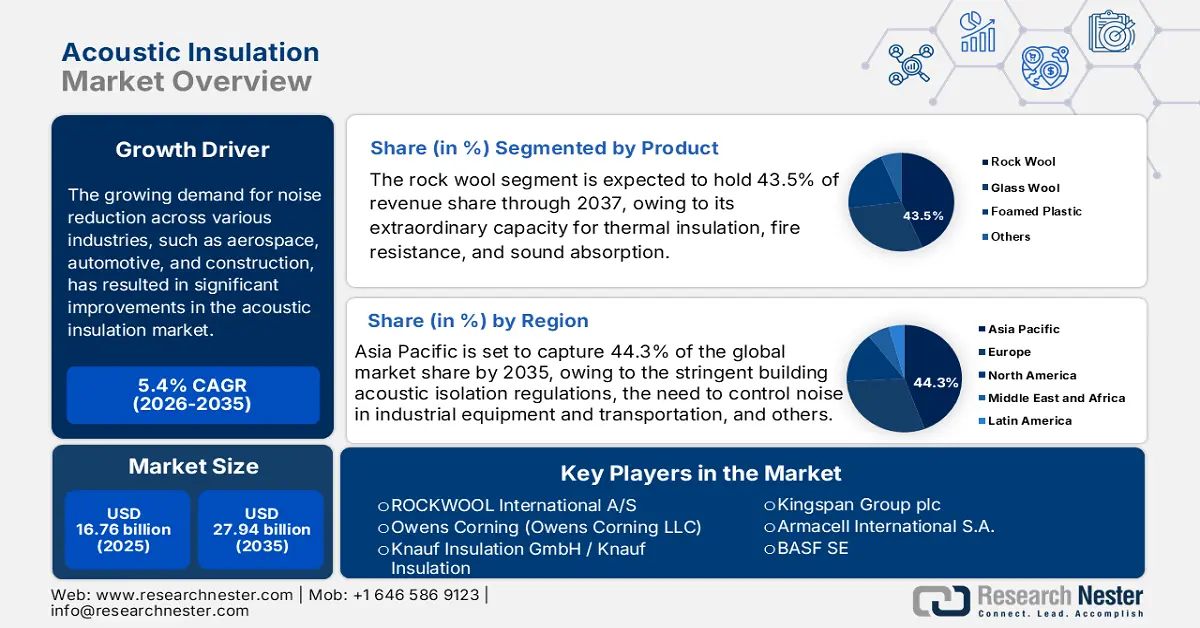
Acoustic Insulation Market size was estimated at USD 16.76 billion in 2025 and is expected to surpass USD 27.94 billion by 2035, rising at a CAGR of 5.4% during the forecast period, i.e., 2026-2035. In 2026, the industry size of acoustic insulation is estimated at USD 17.64 billion.
The growing demand for noise reduction across various industries, such as aerospace, automotive, and construction, has resulted in significant improvements in the acoustic insulation market. The primary factors influencing this market include the increasing need for energy-efficient structures, stricter regulations governing noise, and heightened awareness of the detrimental effects of noise pollution on human health. These factors promote the widespread adoption of advanced insulation materials, enhancing the thermal insulation properties of buildings and vehicles while reducing sound transmission. In October 2023, Lios, a leader in acoustic metamaterial technology, announced that SoundBounce, its ground-breaking innovation, had been honored at the esteemed European Patent Office (EPO) Museum in Munich. This accomplishment represents an important turning point in SoundBounce's history and demonstrates its revolutionary influence on the acoustics industry. Lios' SoundBounce is a significant advancement in acoustic engineering and physics. It has outstanding capacity to reduce noise, an unmatched space-saving design, and steadfast dedication to sustainability.
Acoustic insulation's ability to enhance comfort, functionality, and sound quality has led to a significant increase in its use across specialized industries. It is utilized in the healthcare sector to reduce hospital noise, improving patient recovery and well-being. Hotels and resorts employ it in the hospitality industry to ensure that guests enjoy a tranquil environment, particularly in rooms and common areas. The automotive and aerospace sectors have adopted specialized materials to boost passenger comfort and overall experiences by minimizing noise in automobile and aircraft cabins. Furthermore, entertainment venues such as theaters and concert halls depend on acoustic insulation to establish optimal sound conditions and prevent outside noise interference, significantly enhancing audio quality and audience experience. These specific applications highlight the adaptability and importance of acoustic insulation across various sectors.