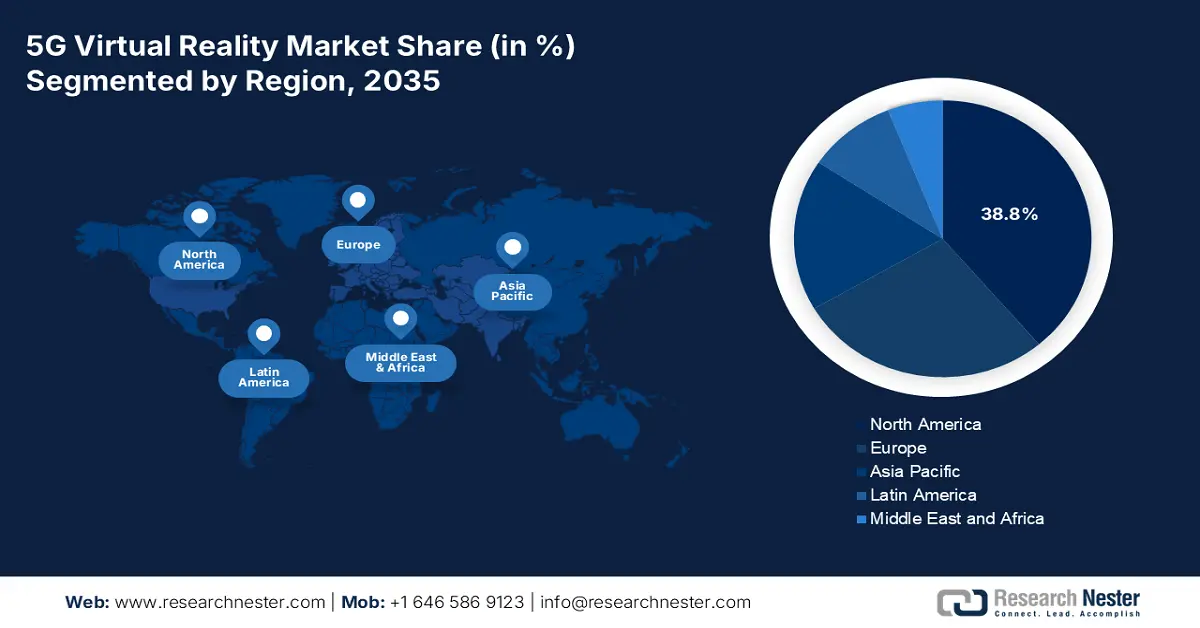
5G Virtual Reality Market - Regional Analysis
North America Market Insights
North America is dominating the 5G virtual reality market and is poised to hold the share of 38.8% by 2035. The 5G virtual reality market is driven by the first-mover advantage in the 5G standalone deployment, substantial defense industrial spending, and a robust venture capital ecosystem for immersive tech. The key drivers include the U.S. Department of Defense’s multi-million-dollar investment in simulation and training, creating a high-value demand pipeline for enterprise and defense VR solutions. Further, Canada’s focused national strategy on digital adoption and 5G infrastructure in rural areas expands the accessible 5G virtual reality market. The primary trend is the shift from the tethered to cloud-rendered standalone professional headsets, fueled by the comprehensive SA coverage from the major carriers. The region is also a hub for R&D in core enabling technologies such as edge computing and AI-integrated VR, supported by the initiatives from the National Science Foundation and Canada’s innovation in Superclusters.
The U.S. 5G virtual reality market is defined by the deep integration of the 5G VR defense and critical infrastructure. The primary trend is the procurement of scalable networked simulation systems for Joint All-Domain Command and Control and soldier readiness backed by the sustained congressional appropriations. The recent trend is the use of 5G VR for the complex equipment maintenance and operational procedures in aviation and energy, leveraging federated digital twins. The DPVR has launched a new 5G cloud VR at CES in April 2021, supporting the demand for shifting from device-bound VR to network-enabled, cloud-based VR, particularly relevant for enterprise and institutional use cases. Further, the expansion of the public 5G SA networks and edge computing enables the transition from the PC, reducing the cost and increasing the flexibility.
Canada’s 5G virtual reality market is propelled by the strategic public investments aimed at digital adoption across the key economic sectors and bridging geographic connectivity divides. A foremost trend is the deployment of the 5G VR solutions for training and remote operations in mining, forestry, and energy supported by the federal programs such as the Innovation Superclusters Initiatives. Further, the market in Canada is gaining momentum with the recent news reporting Rogers Communications launching the nation’s first commercial 5G Standalone network, in March 2022. This deployment enabled a new national 5G core and device certification, providing the essential low latency high reliability connectivity required for the professional-grade cloud-rendered VR applications. Moreover, the infrastructure advancement directly supports the federal priorities outlined in the Canada Digital Adoption Program in June 2024, a USD 4 billion initiative to help businesses adopt digital technologies such as VR for training and operational planning.
APAC Market Insights
Asia Pacific is the fastest-growing 5G virtual reality market and is expected to grow at a CAGR of 26.5% during the forecast period 2026 to 2035. The 5G virtual reality market is driven by the massive state-led investments in the 5G infrastructure, aggressive digitalization of manufacturing, and the world’s largest consumer electronics and gaming base. China’s national strategy prioritizes integrating the 5G VR into smart factories and city management. Japan and South Korea focus on high-value enterprise solutions and premium consumer content, leveraging their advanced semiconductor and display industries. Emerging giants such as India are vital for future scale, with government programs using digital twins for infrastructure planning, and other initiatives for IT hardware aim to boost the local VR device manufacturing. The key trend is the expansion of affordable cloud-based VR experiences, bypassing the need for expensive local processing and making the technology accessible to millions of new users.
The 5G virtual reality market in China is fundamentally shaped by the state-driven industrial policy and real-world applications developed via strategic partnerships between the telecom operators and technology providers. The prime example is the launch of the country’s first 5G VR remote patient visitation system at the West China Hospital in Sichuan province in March 2021, a collaboration between the ZTE Corporation and China Telecom. This system utilized the 5G high-speed, low-latency transmission to power the medical robots and 8K panoramic cameras, allowing the family members to wear VR glasses to conduct immersive, real-time visits with the ICU patients, directly addressing the challenges in visitation. This early, practical deployment exemplifies the application-centric approach mandated by national initiatives like 5G and Industrial Internet.
Recent Developments to the 5G Virtual Reality Market
|
Launch Year |
Company/Consortium |
Aim |
|
August 2024 |
Dang Hong Qi Tian, ZTE, China Mobile, Qualcomm, Xiaomi |
Free-roam immersive VR gaming via 5G-A Minimalist Private Network at ChinaJoy 2024; supports 100+ users at <10ms latency using mmWave and Snapdragon X75 |
|
February 2023 |
Fujitsu (with NTT DOCOMO OREC) |
5G vRAN solution with NVIDIA GPU for virtualized CU/DU; enables global carrier deployment for high-capacity 5G VR infrastructure starting March 2023 |
|
January 2021 |
iQIYI (Qiyu VR) with Qualcomm |
iQiyu 3 headset launch (Q2 2025) powered by Snapdragon XR2 and Q-Light 6DoF CV tech; focuses on untethered gaming/streaming enhanced by 5G connectivity |
Source: ZTE, Fujitsu, iQIYI
The India 5G virtual reality market is experiencing a rapid growth and is fueled by the nation’s massive digital public infrastructure push and expanding 5G connectivity, with the adoption spanning from the consumer-facing innovations to large scalw governemtn projects. Illustrating this consumer and commercial frontier, Bharti Airtel launched India’s first 5 G-powered immersive VR advertisement in October 2022, showcasing a novel format on its Airtel Thanks app to enable deeper brand engagement and signaling the beginning of scalable consumer marketing applications for the technology. This development complements foundational state led initatives that drive the enterprise and public sector demand. The strategic partnerships among the telecom giants and content creators are accelerating this ecosystem, with Airtel collaborating with the major studios to develop native 5G VR experiences.
Europe Market Insights
The Europe 5G virtual reality market is defined by a strong focus on enterprise and industrial applications driven by the strategic EU-wide digital initiatives and significant public-private investment. As a centerpiece of the Eu’s Digital Decade 2030 policy which aims to have all critical entities covered by 5G and to double the EU’s share in the VR/AR production growth is heavily focused on sectors such as advanced manufacturing healthcare training and automotive design, a key driver is the integration of VR with digital twin technology for smart factories and urban planning supported by substantial EU funding. This emphasis on professional applications, combined with the robust data privacy standards, positions Europe as a leader in developing secure, high-value B2B 5G VR solutions rather than mass consumer entertainment.
The Germany 5G virtual reality market is anchored in its world-leading Industrie 4.0 manufacturing sector, where the technology is the vital enabler for the digital twins remote maintenance and complex assembly training. The growth is driven by the federal strategies, such as the 5G strategy for Germany, which prioritizes the industrial campuses and has led to substantial private investment from automotive and engineering giants. A significant growth of the 5G virtual reality market is the deployment of the number of operational 5G base stations. Germany is witnessing an increase of 4%, from 49,571 in 2023 to 56,558 in 2024, based on the Mobile Europe May 2025 data. This extensive infrastructure rollout, mainly focused on industrial sites, is essential for synchronizing physical production lines with their virtual counterparts in real-time.
The UK virtual reailty market is distinguished by the world-class creative industries and a strategic focus on network diversification and security, driving the demand in defense, immersive media, and professional services. A primary example is the BT’s launch of the UK’s first 5G enabled interactive immersive spaces in partnership with immersive interactive Ltd in May 2023. These spaces utilize the EE mobile network to create rooms or mobile units under 360 degree projected content augmented with lights sounds and smells simulates the real environment for training education and consumer experiences early adoption by the institutions such as Cadoxton Primary School in Wales and Borders College in Scotland demonstrates the tangible use of 5G VR for creating and interactive remote classrooms and enhancing the vocational training. This move by a major telecom operator to productize 5G VR for enterprise and the public sector underscores the shift beyond consumer gaming towards scalable, network-dependent B2B solutions that enhance learning, simulation, and remote collaboration.