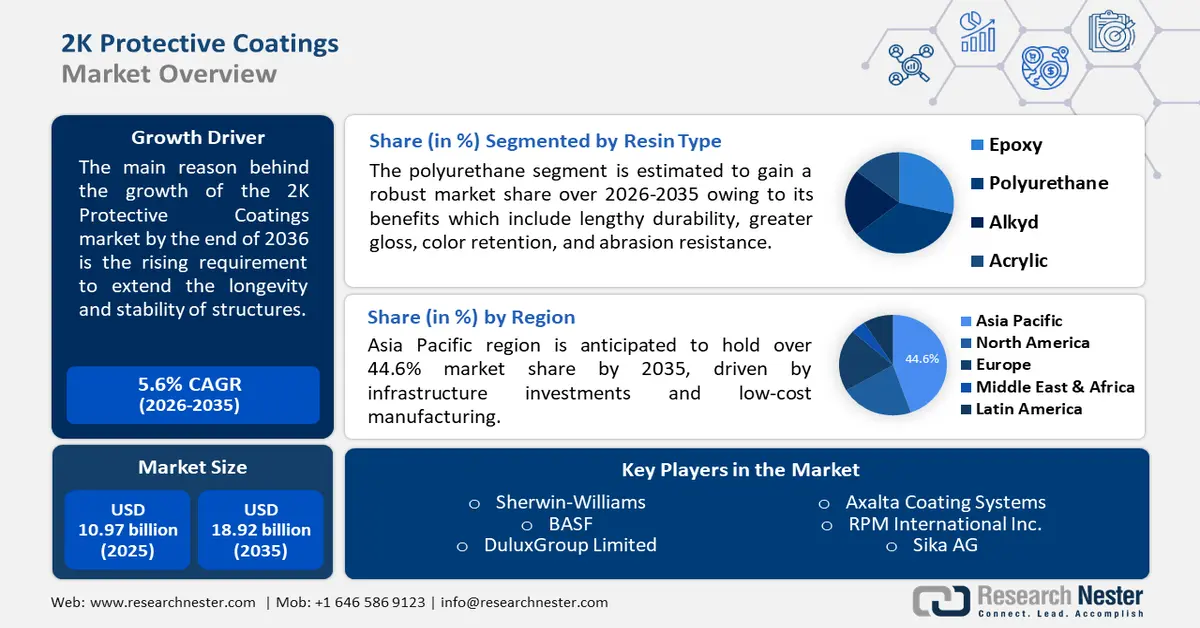
2K Protective Coatings Market Outlook:
2K Protective Coatings Market size was over USD 10.97 billion in 2025 and is projected to reach USD 18.92 billion by 2035, witnessing around 5.6% CAGR during the forecast period i.e., between 2026-2035. In the year 2026, the industry size of 2K protective coatings is evaluated at USD 11.52 billion.
The primary factor that is attributed to the market growth is the expansion of the construction industry in the recent period. Moreover, owing to the rising requirement to extend the longevity and stability of structures, the use of 2K protective coatings has grown in the building and construction industry. It is applied to steelwork, paneling, interior and exterior walls, and wood finishes such as a clear topcoat, a bright color, or varnish in the architectural sector. Furthermore, considering its chemical resistance, it is perfect for coating surfaces in labs, hospitals, recreation centers with pools and spas, and more. In infrastructure projects, where long-term stability and the capacity to survive severe weather conditions, such as acid rains, are necessary to stop leaks and prevent moisture, this kind of coating is also applied to the flooring in bathrooms, kitchens, hotels, and swimming pools. The recent data revealed that in 2020, the total spending in the U.S. construction sector amounted to around USD 2 trillion.
There has been an increase in efficient construction processes, and the longer life of equipment and devices, followed by the rapid industrialization, is anticipated to be a vital factor in escalating market growth. Moreover, the rise in the demand for maintenance of existing substrates in the buildings is further expected to create new opportunities for the global 2K protective coatings market in the forecast period. Thus, the increment in the employment rate in the construction industry is further projected to increase the sales of protective coatings as well. Recent calculations stated that there were almost 10 million construction workers in the United States, approximately 8% of the total working population as of 2021.